
Sweating and the Importance of Electrolytes in Horses
Sweating is the most effective way for a horse to cool down, primarily through the evaporation of sweat. It is triggered by a rise in body temperature. The amount a horse sweats depends on external factors like temperature, humidity, and training intensity. How much does a horse sweat? And when is it necessary to supplement electrolytes?
Understanding Horse Sweating
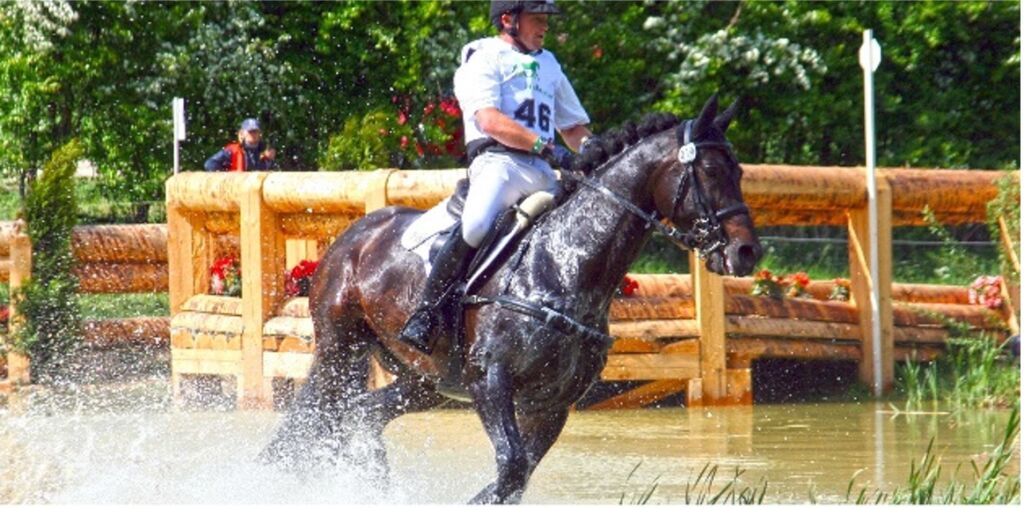
An increase in body temperature triggers sweating in horses. The amount a horse sweats depends on factors like the ambient temperature, humidity, and training intensity. Horses start sweating more quickly and profusely than humans because they have a larger muscle mass that generates more heat, making them less efficient at cooling down.
It’s important to note that significant sweating during training doesn’t always indicate intense exertion. For instance, a horse may sweat during lighter work if it’s in a warm, poorly ventilated indoor arena or has a thick coat. In such cases, it’s easy to mistakenly assume that the horse has worked hard, simply because it has sweated.
Composition of Sweat
A key difference between human and equine sweat is its composition. Horse sweat is hypertonic, which means t contains a higher concentration of salts compared to the horse’s other body fluids. In contrast, human sweat is hypotonic, it contains fewer salts than body fluids (Marlin & Nankervis, 2002). As a result, horses lose a significant amount of electrolytes when they sweat. The primary electrolytes lost are sodium, chloride, potassium, magnesium, and calcium (Lindinger, 2008) with sodium and chloride being the most significant. Replenishing these electrolytes is essential to prevent deficiencies.
Where Do Horses Sweat?
Sweating and the subsequent evaporation of sweat is the most important cooling mechanism for horses (Marlin & Lindinger, 1995). Horses begin to sweat due to an increase in adrenaline in the blood and/or the warming of the skin. Horses typically begin to sweat on their necks, where most sweat glands are located (Sloet, 2014). You may also notice sweat marks under the saddle after training , not because of more active muscles or a higher concentration of sweat glands in this area, but because sweat here can’t evaporate effectively due to lack of air exposure (Marlin & Nankervis, 2002).
The Role of Electrolytes
Due to the hypertonic nature of horse sweat, significant electrolyte loss occurs during sweating. Electrolytes are critical for:
- maintaining fluid balance
- maintaining acid-base balance
- ensuring proper muscle and nerve function
A deficiency in electrolytes can lead to dehydration, reduced performance, and potentially serious health issues (Lindinger, 2022).
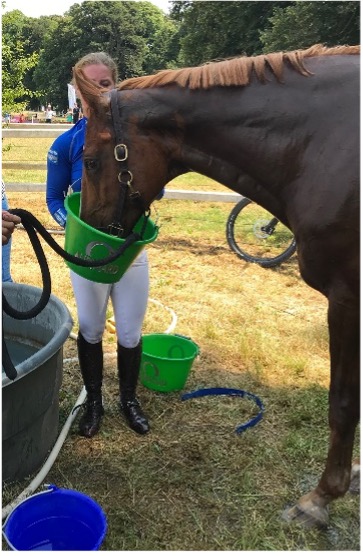
During intense exercise, particularly in hot and humid conditions, horses lose a significant amount of electrolytes through sweat (Marlin & Nankervis, 2002). Even in cooler temperatures, excessive sweating in warm indoor arenas can lead to significant electrolyte loss. To prevent electrolyte deficiencies, it’s important to replenish these losses.
It’s not effective to give electrolytes just before a training in an attempt to build up a buffer since horses can’t store electrolytes in their bodies. However, providing electrolytes with the roughage the night before a hard training or competition can help the horse retain more fluid in the digestive tract. Various supplements are available that can be added to feed or water. Check types, amounts, and ratios of salts in the supplement.
The Use of Salt Licks
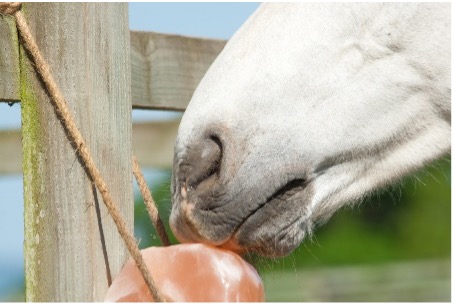
Many horse owners use salt licks, assuming that their horse will get enough electrolytes this way. However, in most cases, a salt lick alone is not sufficient, and supplementation is still necessary to make up for the losses from heavy sweating.
Concerns About Excess Salt
Some people worry about giving their horse too much salt. However, as long as electrolytes are administered with plenty of water, there should be no issues with overconsumption. Excess salts are simply excreted by the body (Lindinger, 2022).
Dehydration in Horses
In addition to electrolyte loss, dehydration is another concern when a horse sweats excessively. Horses start to experience dehydration-related issues when they lose about 5% of their body weight through water loss (Lindinger, 2008). Unlike humans, horses tend to lose their thirst drive when they are at risk of dehydration. This can lead to dangerous situations where they don’t drink enough even when they need to (Lindinger & Marlin, 1995; Sloet, 2014). Therefore, it’s very important to monitor your horse’s water intake and ensure they stay hydrated.
Conclusion
In warm and humid conditions, horses can lose significant amounts of electrolytes through sweat. To prevent potential health issues, it’s essential to replenish electrolyte levels after exercise using a supplement and to ensure your horse has access to plenty of water.
Sources
- Lindinger M.I & Marlin D.J (1995). Heat stress and acclimation in the performance hors: where we are and where we are going. Equine vet. Educ., 7 (5), 256-262.
- Lindinger M.I (2008). Sweating, dehydration and electrolyte supplementation: Challenges for the performance horse. Wageningen University and Research Centre, 28-45.
- Lindinger M.I (2022). Oral Electrolyte and Water Supplementation in Horses. Sci. 9(11), p. 626
- D & Nankervis. K (2002). Thermoregulation. Equine Exercise Physiology
- McCutcheon L. Jill & Geor J. Raymond (2008). Thermoregulation and exercise-associated heat stress.Equine Exercise Pshysiology, 382-396.
- M (2014). Hittestress bij het paard. Dier en Arts
- M (2014). Oververhitting. Paard&Sport
Recente berichten
- Blankets for Horses: When Are They Really Necessary? 14 November 2024
- Young Friesian horses show familial aggregation in fitness response to a 7-week performance test 30 October 2024
- A prospective study on a cohort of horses and ponies selected for participation in the European Eventing Championship: reasons for withdrawal and predictive value of fitness tests 30 October 2024
- Exercise testing in Warmblood sport horses under field conditions 30 October 2024
- A prospective cohort study on the acute:chronic workload ratio in relation to injuries in high level eventing horses: A comprehensive 3-year study 30 October 2024