
Physiological and behavioral responses of horses during police training
C. B. M. Munsters, E. K. Visser, J. van den Broek & M. M. Sloet van Oldruitenborgh-Oosterbaan (2012). Animal, 7(5), pp. 822-827. https://doi.org/10.1017/S1751731112002327
Background
Police horses must stay calm in unpredictable situations for the reasons of public safety and the security of the police officers, and of course, for their own welfare. Horse–rider miscommunications and/or the use of unsuitable horses, are contributing factors in accidents, behavioural problems and wastage. Performance scores have been used to select police dogs, but no studies are available on the selection of police horses for their work. This study evaluated the responses of experienced and inexperienced police horses during training using physiological and behavioural metrics.
Methodology
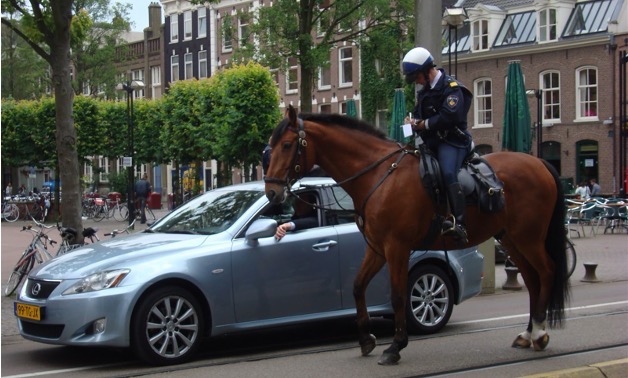
The study involved 12 Warmblood police horses of the Dutch police department, six horses were experienced (>9 months), 6 inexperienced (<1 month). They participated in four police training tests: the outdoor track, street track, smoke machine tests, and the indoor arena test, designed to simulate police work. Each horse performed all tests three times on 3 consecutive days in weeks 1, 3 and 7, while wearing a heart rate monitor. Behaviour was scored on a scale from 0 to 5. Simultaneously, a police performance score (PPS) was given by two experienced police trainers for each test. Performance was graded as ‘pass’ for a police horse (PS-0) when horses reacted calmly, or as ‘no-pass’ (PS-1) when there was an excitement response.
Results
hearThe study showed that age and experience did not significantly affect police horses’ heart rate (HR), heart rate variability and behavioural score (BS). Experienced horses, however, received higher police performance scores (PPS). A low BS was not always indicative of a low HR; some (introvert) horses with low BS had increased HRs compared with other horses with the same BS during the same activity. For the selection process of police horses it is important to distinguish between horses that are really calm and those that seemed calm but had increased HRs. Therefore, HR measurements may provide useful complimentary information during this process. The police horses overall experienced relatively low amounts of stress during these police training tests, suggesting that this kind of police work is not significantly stressful for horses and it would have no negative impact on the horse’s welfare.
Police horses experience relatively low stress during police training tests, suggesting that police work has no negative impact on the horse’s welfare.
Recente berichten
- Blankets for Horses: When Are They Really Necessary? 14 November 2024
- Young Friesian horses show familial aggregation in fitness response to a 7-week performance test 30 October 2024
- A prospective study on a cohort of horses and ponies selected for participation in the European Eventing Championship: reasons for withdrawal and predictive value of fitness tests 30 October 2024
- Exercise testing in Warmblood sport horses under field conditions 30 October 2024
- A prospective cohort study on the acute:chronic workload ratio in relation to injuries in high level eventing horses: A comprehensive 3-year study 30 October 2024