
The influence of challenging objects and horse-rider matching on heart rate, heart rate variability and behavioural score in riding horses
Carolien C.B.M. Munsters, Kathalijne E.K. Visser, Jan van den Broek, Marianne M. Sloet van Oldruitenborgh-Oosterbaan (2011). The Veterinary Journal, 192(1), pp. 75-80. https://doi.org/10.1016/j.tvjl.2011.04.011
Background
A horse’s welfare directly impacts its performance and health. Research into equine welfare primarily focussed on environment influences rather than horse-rider interactions, which is considered a factor influencing equine welfare. In dressage, a harmonious horse-rider “match” is essential for effective communication. Poor matches (‘mismatch’) can lead to unsafe situations, and may negatively impact the horse’s welfare. This study examined how horse-rider matching and repeated exposure to challenging objects affect horse stress levels.
Methodology
The study included 16 Dutch Warmblood horses and 21 female student riders of the international level 3 Education of the Riding Instructor Eligible Qualification scale of the International Group for Equestrian Qualifications (IGEQ). Each horse was ridden 3 times in an indoor arena, every time ridden by a different rider. The horses faced three obstacles (a blue sail, a red ball, and a narrow passage), while heart rate (HR) and heart rate variability (HRV) were measured of horse and rider. After completion of all tests, a behavioural score (BS) between 0 (completely relaxed) to 10 (very anxious), was awarded for each test and for each object. The same observer also determined wether horse and rider were a match or mismatch based on harmonious communication. Additionally, horses were classified as fully compliant, partly compliant, or non-compliant depending on how many of the three riders they matched with.
Results
Horses’ HR and BS decreased with repeated exposure to the obstacles. The decreased stress-related behaviour within each test and at each object suggests that the horses adapted to these challenges. Reactions differed between horses. This is in line with the ‘coping strategy’ hypothesis which suggests that some individual animals respond pro-actively, whereas others passively wait for the event before responding.
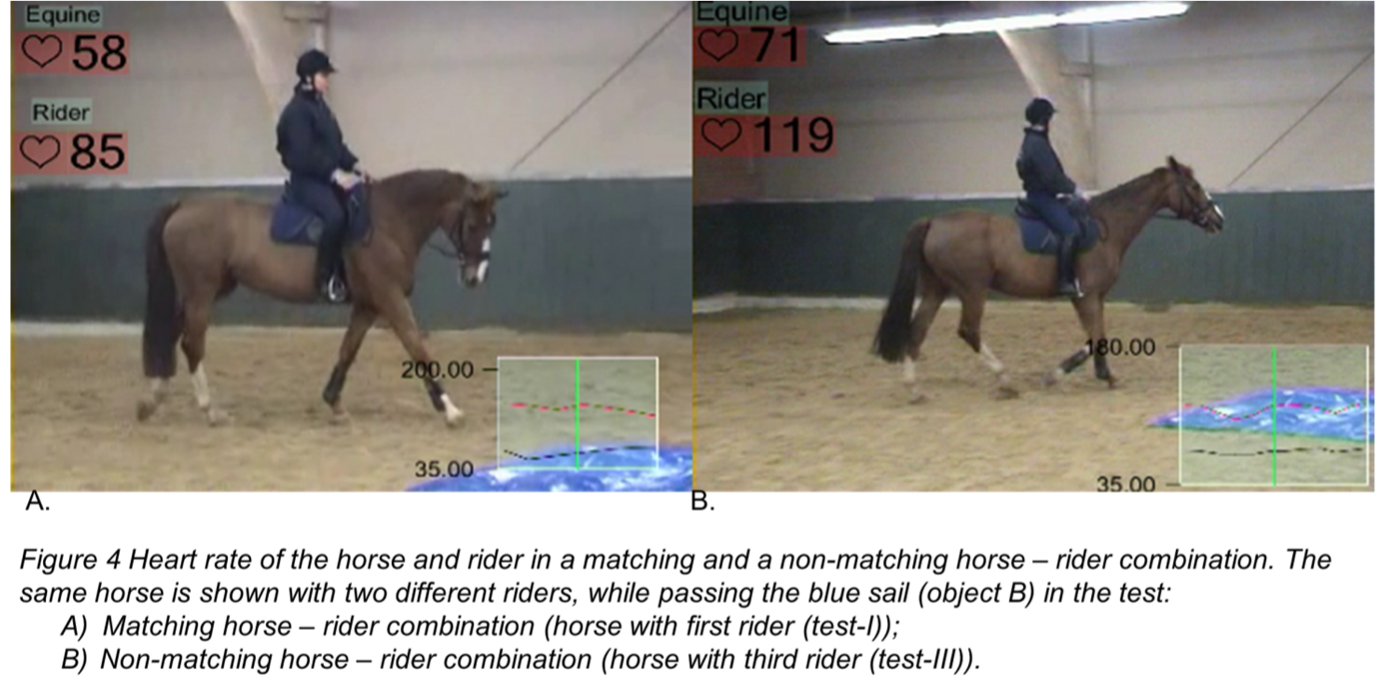
Rider-match proved to have a significant influence on the apparent stress experienced by the horses during the tests: a good match resulted in novel objects provoking less stress in terms of the horse’s behaviour and HR. Non-compliant horses had significantly higher HR than compliant horses, but no significant difference in BS were found, suggesting that compliance should be scored using objective parameters such as HR. No significant HRV differences were found between matched or mismatched pairs or among compliant and non-compliant horses.
Horse-rider-match proved to have a significant influence on the apparent stress experienced by horses and riders during the tests.
Recente berichten
- Blankets for Horses: When Are They Really Necessary? 14 November 2024
- Young Friesian horses show familial aggregation in fitness response to a 7-week performance test 30 October 2024
- A prospective study on a cohort of horses and ponies selected for participation in the European Eventing Championship: reasons for withdrawal and predictive value of fitness tests 30 October 2024
- Exercise testing in Warmblood sport horses under field conditions 30 October 2024
- A prospective cohort study on the acute:chronic workload ratio in relation to injuries in high level eventing horses: A comprehensive 3-year study 30 October 2024